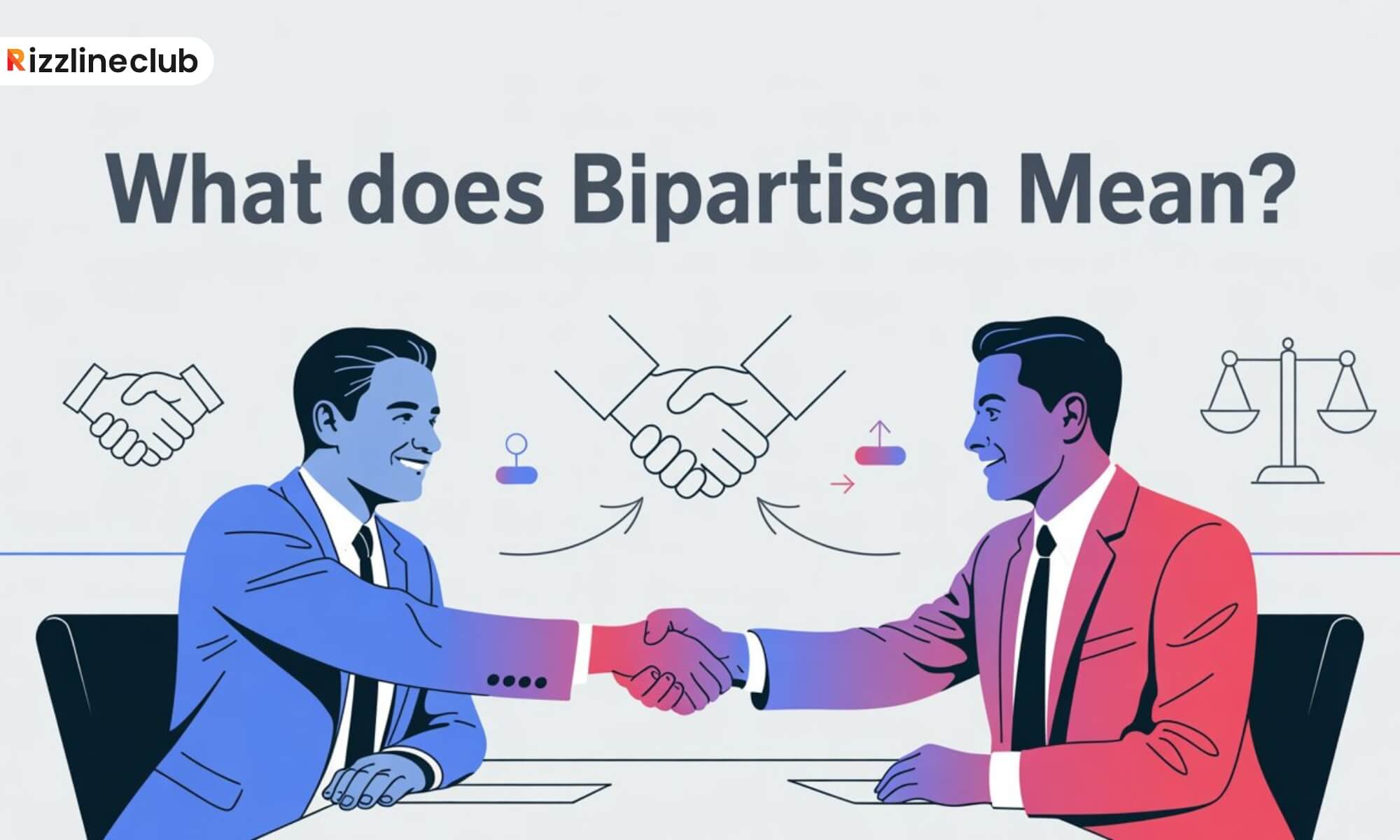
Ever scrolled past a political post and stumbled on the word “bipartisan”, only to pause and think, “Okay… bi-what now?” Don’t worry — most of us have been there. I remember seeing it in a heated comment thread and pretending I totally understood it… then immediately Googling it. 😅
If you’ve seen bipartisan used in texts, news, TikToks, or political memes and felt confused, this guide breaks it down in the simplest, most relatable way.
Quick Answer: Bipartisan means “supported by two political parties.” It’s a neutral, formal word used to describe agreement, cooperation, or teamwork between two sides — usually Democrats and Republicans in the U.S.
🧠 What Does Bipartisan Mean in Text?
In simple words, bipartisan describes something that both major political parties agree on.
It’s commonly used in political discussions, news updates, and debates — especially when talking about laws, decisions, or public issues.
Think of it like saying:
“Both sides are actually working together on this.”
⭐ Example:
“Looks like they finally passed a bipartisan bill on student loans.”
In short: bipartisan = two parties working together = shared political agreement.
📱 Where Is “Bipartisan” Commonly Used?
You won’t see bipartisan in flirty DMs or casual memes. 😆
It shows up mostly in:
🗞 News articles
🏛 Political discussions
💬 Twitter/X debates
🎥 TikToks or Reels explaining politics
🧵 Reddit threads (especially r/politics)
📚 School or college assignments
💼 Work conversations about policy or government topics
Tone:
- It is formal, neutral, and informational
- Not slang
- Not casual or humorous by default (though people can use it sarcastically)
💬 Examples of “Bipartisan” in Conversation
Here are short, realistic conversations showing how people use it online or in texts:
1.
A: “Did you see the vote today?”
B: “Yeah, shockingly bipartisan 😂”
2.
A: “Is that bill actually going to pass?”
B: “Maybe. It has bipartisan support now.”
3.
A: “Why’s everyone suddenly talking about this law?”
B: “Because both parties agreed on it — it’s bipartisan.”
4.
A: “Is this a left or right thing?”
B: “Neither really. It’s bipartisan.”
5.
A: “I don’t get the hype.”
B: “It’s rare to see anything bipartisan lately lol.”
6.
A: “Are they still fighting about it?”
B: “Surprisingly no, they reached a bipartisan deal.”
7.
A: “Is that good news?”
B: “Usually. Bipartisan means they’re actually working together.”
🕓 When to Use and When Not to Use “Bipartisan”
✅ When to Use ‘Bipartisan’
Use it when you want to describe:
Political agreement between two major parties
A law that passed with support from both sides
Cooperation in government
Neutral or factual discussions
School essays or professional messages about policy
News summaries
❌ When NOT to Use ‘Bipartisan’
Avoid it when:
- You’re chatting casually with friends
- The topic has nothing to do with politics
- You’re joking around or sending memes
- You need simple language for a general audience
- You’re in a non-political argument (it’ll just sound weird)
⭐ Comparison Table
| Context | Example Phrase | Why It Works |
|---|---|---|
| Friend Chat | “They actually made a bipartisan decision 😮” | Works when discussing news casually |
| Work Chat | “The bill has bipartisan backing, so it will likely pass.” | Professional & informative |
| “This initiative received bipartisan support in Congress.” | Clear, formal, appropriate | |
| Casual DM | “lol that meme is so bipartisan” | ❌ Doesn’t fit unless intentionally sarcastic |
| School Essay | “The reform was made possible by bipartisan cooperation.” | Smart, academic, correct |
🔄 Similar Words or Alternatives
| Word | Meaning | When to Use |
|---|---|---|
| Nonpartisan | Not tied to any political party | Neutral discussions, organizations, voting info |
| Cross-party | Cooperation between members of different parties | International contexts or general politics |
| Bicameral support | Support from both chambers (House + Senate) | Government or legislative discussions |
| Consensus | General agreement | Team decisions, workplace settings, group debates |
| Coalition | Temporary alliance for a joint purpose | Political groups joining forces |
| Unified vote | Everyone voted the same way | Describing unanimous decisions |
❓ FAQs About “Bipartisan”
1. Is “bipartisan” a slang word?
No — it’s a formal political term, not slang.
2. Does bipartisan always mean “good”?
Not automatically. It just means both parties agree, whether people like the decision or not.
3. Is bipartisan the same as nonpartisan?
No.
Bipartisan = supported by two opposing parties.
Nonpartisan = not aligned with any party.
4. Can I use bipartisan in everyday texting?
Only if you’re talking about politics. Otherwise, it sounds overly serious.
5. What’s an example of a bipartisan issue?
Things like national security, disaster relief, or certain economic policies sometimes gain support from both parties.
6. Why do people on social media use it sarcastically?
Because in today’s political world, it’s rare for both parties to agree — so people joke about it.
7. Is bipartisan only used in the U.S.?
Mostly, yes. Other countries also use it, but the term is most common in American politics.

Marconi is the creative mind behind Rizz Line Club, your go-to hub for the smoothest rizz lines, clever captions, and charming one-liners. With a passion for wordplay and viral trends, Marconi brings fresh, witty, and relatable content that keeps your socials lit and your DMs winning. When he's not crafting the perfect rizz, he's probably decoding pop culture or vibing with meme-worthy humor.
- Marconihttps://rizzlineclub.com/author/info-irtazagmail-com/

- Marconihttps://rizzlineclub.com/author/info-irtazagmail-com/

- Marconihttps://rizzlineclub.com/author/info-irtazagmail-com/

- Marconihttps://rizzlineclub.com/author/info-irtazagmail-com/